What is Strategic Communications?
//what is strategic communications?
ICPA has adopted a strategic communications approach to integrate our more recent work on narrative change targeting public debates with our long-standing work focused on policy advocacy. We’ve seen that the size of the challenge on issues that currently polarise society (e.g. migration and civic space) requires a more-encompassing and broader response to achieve lasting change (or something more vibrant to really turn the tide).
As a result, we’ve embraced a longer-term strategy that moves beyond individual or ad-hoc interventions, going beyond what is normally considered communications work to incorporate the multi-faceted work of organisations and networks. Going to the movement level, our focus is to support different organisations/networks to appreciate and play their (specific or suitable?) role in creating the narrative power needed to not only shift public debates, but ultimately target a change in norms and rules (legal/policy change): a strategic communication approach.
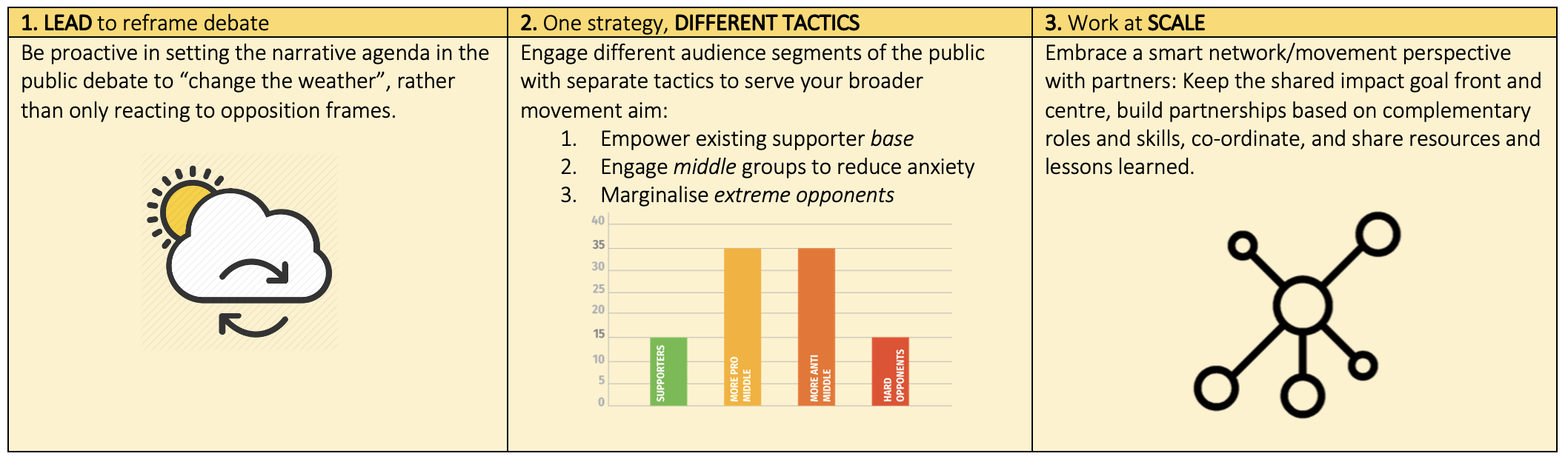
Strategic communications as a theory of change:

Three guiding principles: